

Black triangles between teeth: causes and treatment
November 17, 2026
A plain-English guide for patients in Bristol, the South West and South Wales
Reading time: about 4 minutes | Last updated: 5 November 2026 | Clinically reviewed by: Saba Samadi, Master of Clinical Dentistry (MClinDent) at Cardiff University, Royal College of Surgeons of Edinburgh (MPROS), GDC no. 304230

November 17, 2026
Black triangles are the small dark gaps that can appear between teeth, close to the gumline. They are very common, especially from middle age onwards, and many people only notice them after brace treatment or a course of gum treatment.
The short answer: a black triangle appears when the small point of gum between two teeth no longer fills the space. The usual causes are gum disease, gum shrinkage, tooth shape and tooth movement. They are mainly a cosmetic concern, though food can trap in them. The gum rarely grows back, so treatment usually works by reshaping the teeth with composite bonding or by moving them closer together.
What is a black triangle?
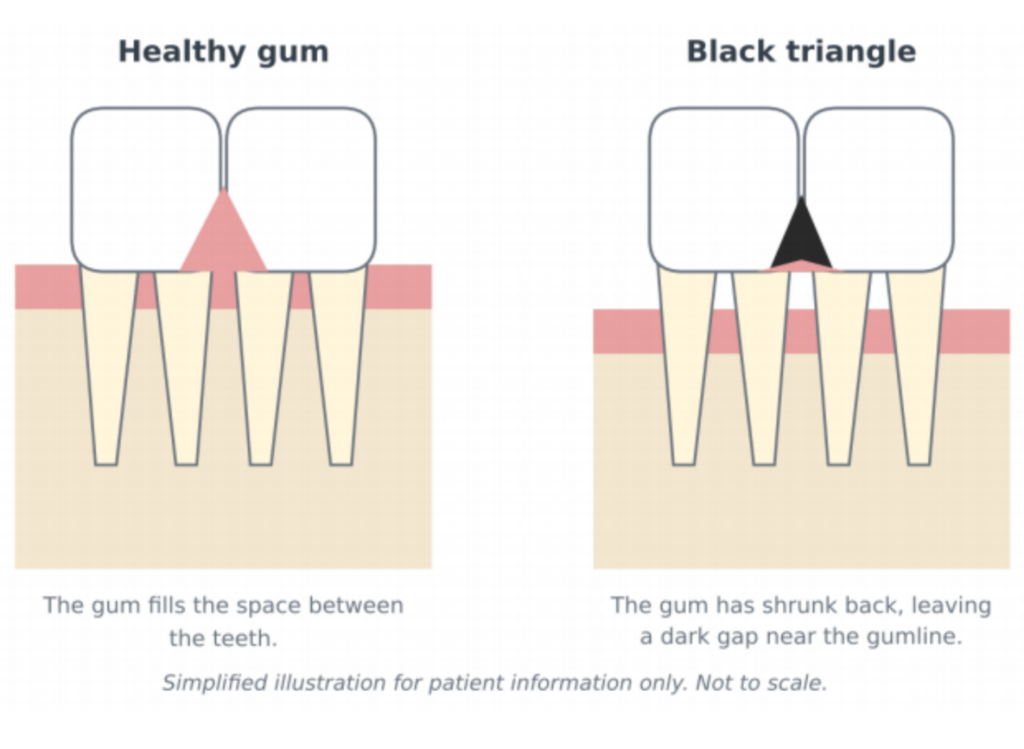
Between each pair of teeth sits a small peak of gum called the papilla. It is supported by the bone underneath. If the bone level drops, or the teeth touch further from the gum, the papilla cannot reach high enough to fill the gap, and a dark triangular space shows.
What causes them?
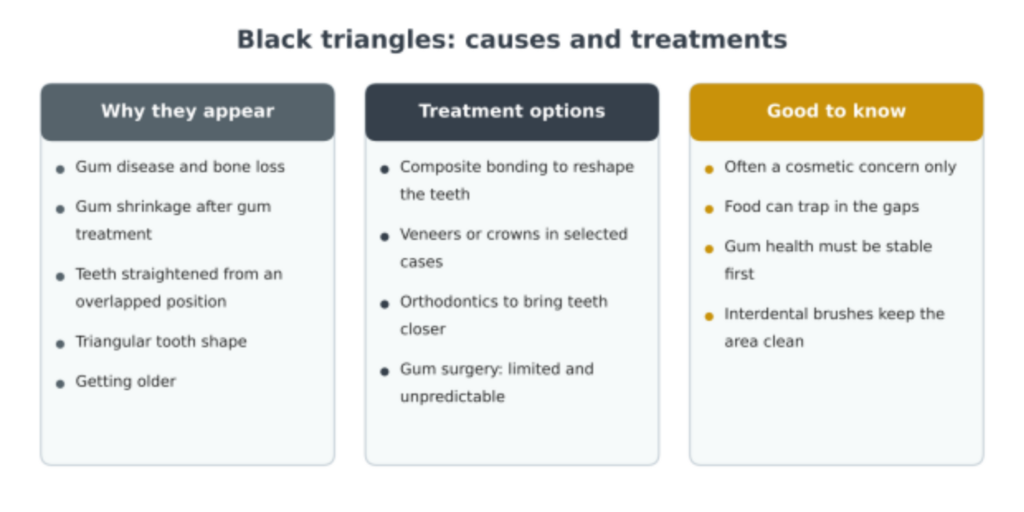
- Gum disease. Loss of bone between the teeth is the most common cause.
- Successful gum treatment. As swollen gums become healthy they shrink and tighten. The triangles are a sign the swelling has gone, though they can be an unwelcome surprise.
- Brace or aligner treatment. When overlapped teeth are straightened, a space that was hidden is revealed. This is common in adults.
- Tooth shape. Teeth that are wide at the tip and narrow at the neck touch only near the biting edge.
- Age and gum recession, sometimes made worse by brushing too hard.
Do they matter?
Often they are purely cosmetic. They can trap food, and some people notice a slight change in speech or air escaping. If the cause is gum disease, though, the disease does need treatment.
Can the gum grow back?
Usually not. Once the supporting bone is lost, the papilla has nothing to rest on. Surgical techniques to rebuild it exist, but results are limited and unpredictable. Injections of filler into the gum have been tried and tend to be short-lived. Most treatment therefore changes the teeth, not the gum.
How can black triangles be treated?
Composite bonding
Tooth-coloured resin is added to the sides of the teeth near the gum to close the space. No drilling is usually needed. Done carefully, with smooth contours you can clean around, this is often the simplest and most conservative solution. It may stain or chip and needs maintenance. See our guide to composite bonding.
A modern solution: Closing black triangles with Bioclear
Traditionally, treating black triangles could be challenging, particularly when a patient wants to avoid more extensive dental treatment.
With the Bioclear Method, we can use specially designed matrices and tooth-coloured composite resin to reshape the sides of the teeth and close the unwanted spaces. Unlike conventional composite bonding, the Bioclear technique allows us to create a more controlled, anatomically contoured restoration around the teeth.
The aim is to achieve a natural-looking result, with smooth transitions between the teeth and restorations, while preserving as much natural tooth structure as possible. This method offers a more controlled and predictable restorative approach.
Orthodontics with reshaping
The sides of the teeth are slimmed very slightly and the teeth moved closer together, so they touch nearer the gum and the papilla fills more of the space. This can be planned as part of brace or aligner treatment.
Veneers or crowns
These can close spaces by changing the shape of the teeth, but they remove healthy tooth. They are generally reserved for teeth that would benefit from them for other reasons.
A gum veneer
For large gaps after advanced gum disease, a thin removable gum-coloured mask can be made to cover the spaces.
Leaving them
Many people choose to accept small triangles and simply keep them clean.
Gum health comes first
No cosmetic treatment should be done on unhealthy gums. If there is gum disease, it needs to be treated and stable beforehand. Read more about periodontics.
Keeping the spaces clean
Use interdental brushes of the right size every day. Your hygienist can show you which sizes fit. Take care not to force a brush that is too big, as this can injure the gum.
Risks and realistic expectations
Bonding must be shaped so that plaque does not collect under an overhang, or the gum will become inflamed. Very large triangles may not be fully closed without making the teeth look too wide. Your clinician will show you what is achievable before you commit.
Frequently asked questions
Will black triangles get worse?
They can, if gum disease continues or the gums recede further. Good cleaning and regular care help to keep them stable.
Can they be prevented during brace treatment?
Your orthodontist can often predict them and plan to reduce them. Ask about this before starting.
Does bonding for black triangles last?
It varies. Expect to need polishing and occasional repair over the years.
Help with black triangles in Bristol
Bristol Dental Specialists is a private specialist and referral practice at 24 Berkeley Square, Clifton, seeing patients from Bristol, Bath, Somerset, Gloucestershire and South Wales, by referral or directly.
Your next step
If black triangles are bothering you, an assessment will show why they have appeared and what can realistically be done. Gum health is checked first, as it decides which options are open to you.
Call: 0117 450 2991 Online: contact us or book a consultation Dentists: refer a patient
Visit: Bristol Dental Specialists, 24 Berkeley Square, Clifton, Bristol, BS8 1HP
Important information. This article gives general information and is not a substitute for individual advice from a dental professional who has examined you. Suitability, risks, timings, costs and results vary from person to person. Bristol Dental Specialists is a private dental practice. Our dental professionals are registered with the General Dental Council (GDC), 37 Wimpole Street, London, W1G 8DQ, www.gdc-uk.org. If you are unhappy with any aspect of your care, please see our complaints procedure.

Opening Hours
Monday 8.00am – 7.00pm
Tuesday 8.00am – 7.00pm
Wednesday 8.00am – 6.00pm
Thursday 8.00am – 6.00pm
Friday 8.30am – 2.30pm
Saturday By arrangement only
Sunday Closed
Bristol Dental Specialists Ltd Registered in England & Wales company number 11696017
Bristol Dental Specialists, 24 Berkeley Square, Bristol, Gloucestershire, BS8 1HP. Telephone 0117 450 2991. Bristol Dental Specialists Ltd trading as Bristol Dental Specialists is a credit broker not a lender and is authorised and regulated by the Financial Conduct Authority, 914167. Registered in England & Wales 11696017. Registered Address: 24 Berkeley Square, Bristol, Gloucestershire, BS8 1HP.
© Copyright Bristol Dental Specialists 2020-26 | Website by QualiConvert