

Jaw pain, clicking or teeth grinding? TMJ treatment and splints explained
November 03, 2026
Jaw pain, clicking or teeth grinding? TMJ treatment and splints explained
November 03, 2026
A plain-English guide for patients in Bristol, the South West and South Wales
Reading time: about 4 minutes | Last updated: 20 October 2026 | Clinically reviewed by: Saba Samadi, Master of Clinical Dentistry (MClinDent) at Cardiff University, Royal College of Surgeons of Edinburgh (MPROS), GDC no. 304230

November 03, 2026
An aching jaw, a joint that clicks when you yawn, or a partner who says you grind your teeth at night: these are very common problems, and they are often linked. The good news is that most settle with simple measures.
The short answer: pain and clicking in the jaw joint and chewing muscles is known as TMD (temporomandibular disorder). It is often linked with clenching or grinding, stress and poor sleep. Most cases improve within weeks or months with rest, jaw exercises and simple pain relief. A custom-made night splint can protect the teeth and ease the muscles. Surgery is rarely needed.
What is the TMJ?
The temporomandibular joint (TMJ) is the hinge just in front of each ear that connects your lower jaw to your skull. Problems can arise in the joint itself, in the muscles that move it, or both.
What are the symptoms?
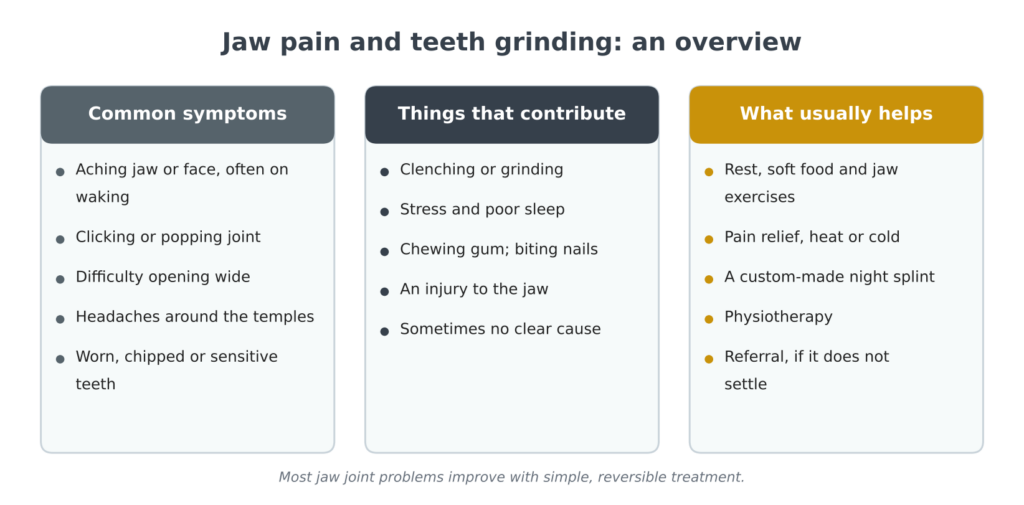
- Aching in the jaw, face or temples, often worse on waking or after chewing
- Clicking, popping or grating from the joint
- Difficulty or pain when opening wide; occasionally the jaw locks
- Headaches, earache or a feeling of fullness in the ear
- Teeth that are worn, chipped, cracked or sensitive
A click with no pain is common and usually needs no treatment.
What causes it?
There is rarely a single cause. Contributing factors include:
- Clenching and grinding (bruxism), by day or during sleep
- Stress, anxiety and poor sleep
- Habits such as chewing gum, biting nails or pens
- An injury to the jaw or a long dental appointment with the mouth held open
- Arthritis in the joint, less commonly
What can you do yourself?
- Eat softer food and cut it small. Avoid chewy and hard foods for a few weeks.
- Avoid chewing gum and wide yawning.
- Keep your teeth apart when you are not eating: lips together, teeth apart, tongue resting on the roof of your mouth.
- Apply a warm or cold pack to the jaw for 10 to 15 minutes.
- Take simple pain relief such as paracetamol or ibuprofen if suitable for you.
- Look at sleep and stress. Relaxation techniques and regular exercise help many people.
How can a dentist help?
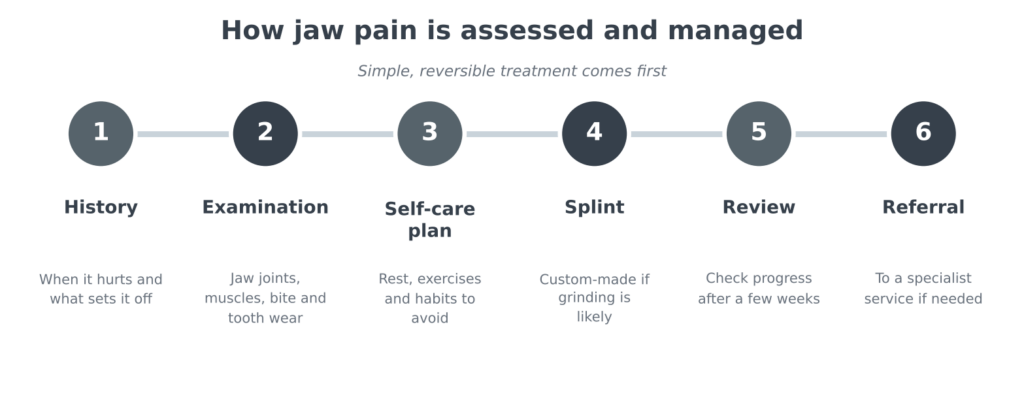
Your clinician will ask about your symptoms, examine the joints, muscles and bite, and look for signs of tooth wear. X-rays or scans are needed only occasionally.
Splints and night guards
A splint is a custom-made cover that fits over the upper or lower teeth, usually worn at night.
- A hard stabilisation splint, such as a Michigan splint, is made of rigid acrylic and carefully adjusted so that the teeth meet it evenly. It protects the teeth from grinding and can help the jaw muscles relax.
- A soft guard is simpler and cheaper, and useful in the short term, though some people chew on it.
- A B splint and similar small designs cover only some teeth and are used in specific situations under close supervision.
A splint does not stop you grinding, and it does not help everyone, but many people find it eases symptoms and it prevents further tooth damage.
Other treatment
Physiotherapy, and help with stress or sleep, can be valuable. If your teeth are badly worn or cracked, they may need restoring. Irreversible treatments such as grinding the teeth to change the bite, or jaw surgery, are not recommended as a first approach.
When should you seek help?
See your dentist if symptoms last more than a couple of weeks, are getting worse or affect eating and sleeping. Persistent cases can be referred to a hospital oral and maxillofacial or oral medicine service.
Seek urgent medical advice if you have jaw pain together with chest pain or breathlessness; a jaw that is locked open or shut; swelling of the face; or, if you are over 50, a new headache with scalp tenderness or pain on chewing that eases when you stop.
Frequently asked questions
Will it go away on its own?
Often, yes. Most cases improve over a few weeks to months with simple self-care.
Is my bite the cause?
Research suggests the bite is rarely the main cause, which is why permanent changes to the teeth are not advised as a first step.
Can I buy a mouthguard online or from a chemist?
Shop-bought guards are cheap but bulky and can alter your bite if used long term. A custom-made splint is fitted and adjusted to you.
Is teeth grinding harmful?
Mild grinding often does no harm. Heavy grinding can wear, crack or loosen teeth and break fillings and crowns.
Help with jaw pain in Bristol
Bristol Dental Specialists is a private specialist and referral practice at 24 Berkeley Square, Clifton, seeing patients from Bristol, Bath, Somerset, Gloucestershire and South Wales, by referral or directly.
Your next step
If jaw pain, clicking or grinding is affecting you, an assessment can identify the likely cause and the simplest way to manage it. We will explain what you can do yourself and whether a splint would help.
Call: 0117 450 2991 Online: contact us or book a consultation Dentists: refer a patient
Visit: Bristol Dental Specialists, 24 Berkeley Square, Clifton, Bristol, BS8 1HP
Important information. This article gives general information and is not a substitute for individual advice from a dental professional who has examined you. Suitability, risks, timings, costs and results vary from person to person. Bristol Dental Specialists is a private dental practice. Our dental professionals are registered with the General Dental Council (GDC), 37 Wimpole Street, London, W1G 8DQ, www.gdc-uk.org. If you are unhappy with any aspect of your care, please see our complaints procedure.

Opening Hours
Monday 8.00am – 7.00pm
Tuesday 8.00am – 7.00pm
Wednesday 8.00am – 6.00pm
Thursday 8.00am – 6.00pm
Friday 8.30am – 2.30pm
Saturday By arrangement only
Sunday Closed
Bristol Dental Specialists Ltd Registered in England & Wales company number 11696017
Bristol Dental Specialists, 24 Berkeley Square, Bristol, Gloucestershire, BS8 1HP. Telephone 0117 450 2991. Bristol Dental Specialists Ltd trading as Bristol Dental Specialists is a credit broker not a lender and is authorised and regulated by the Financial Conduct Authority, 914167. Registered in England & Wales 11696017. Registered Address: 24 Berkeley Square, Bristol, Gloucestershire, BS8 1HP.
© Copyright Bristol Dental Specialists 2020-26 | Website by QualiConvert