

INSIGHT | A SMILE TO LAST A LIFETIME
September 14, 2023
A plain-English guide to cosmetic options for patients in Bristol, the South West and South Wales
Reading time: about 4 minutes| Last updated: 14 October 2026 | Clinically reviewed by: Saba Samadi, Master of Clinical Dentistry (MClinDent) at Cardiff University, Royal College of Surgeons of Edinburgh (MPROS), GDC no. 304230

October 14, 2026
If you are unhappy with chipped, uneven, gappy or discoloured teeth, three treatments come up again and again: composite bonding, veneers and crowns. They can all change your teeth’s appearance, but they are very different in regard to how much natural tooth needs to be removed, how long they last and what they cost.
The short answer: Composite bonding adds tooth-coloured resin with little or no drilling. It usually costs less but needs more maintenance. Veneers cover the front of the tooth and can provide longer-lasting cosmetic results, but some enamel is usually removed permanently. Crowns cover the whole tooth and are generally best suited to teeth that are weakened, broken or heavily filled.
The three treatments explained
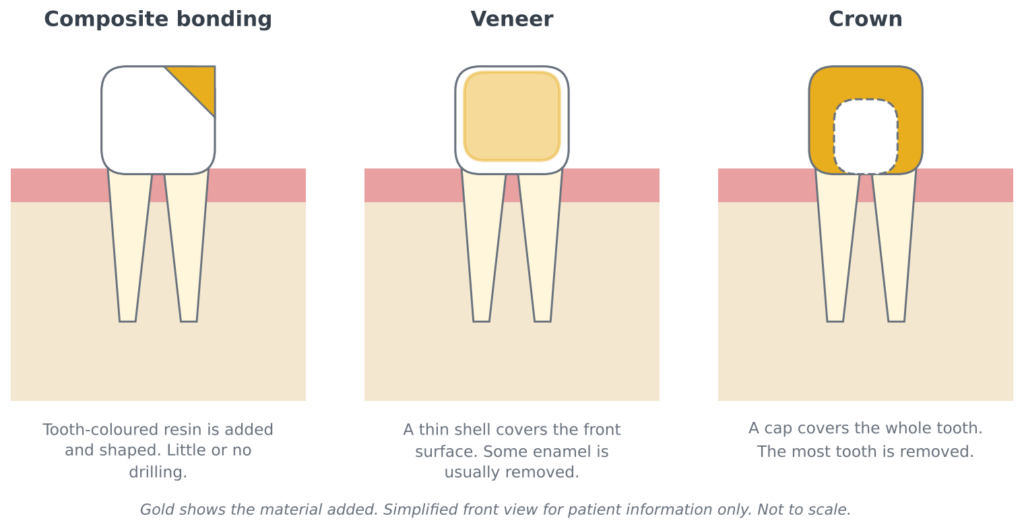
Composite bonding
A tooth-coloured resin is applied, shaped by hand and polished. It can close small gaps, repair chips, lengthen worn edges and even out shapes. It is usually done in one visit with no injections, and little or no healthy tooth is removed, so it is largely reversible.
Veneers
A veneer is a thin shell of material bonded to the front of a tooth. A small amount of enamel is normally removed first, so the tooth will always need a veneer or similar covering afterwards.
Crowns
A crown is a cap covering the whole tooth. More tooth will be removed than for a veneer. Modern crowns are made from strong ceramics such as lithium disilicate (often known by the brand name E.max) or zirconia, though can be porcelain as well. Crowns are mainly a way to protect and strengthen damaged teeth and are not usually the first choice for healthy teeth.
How do they compare?
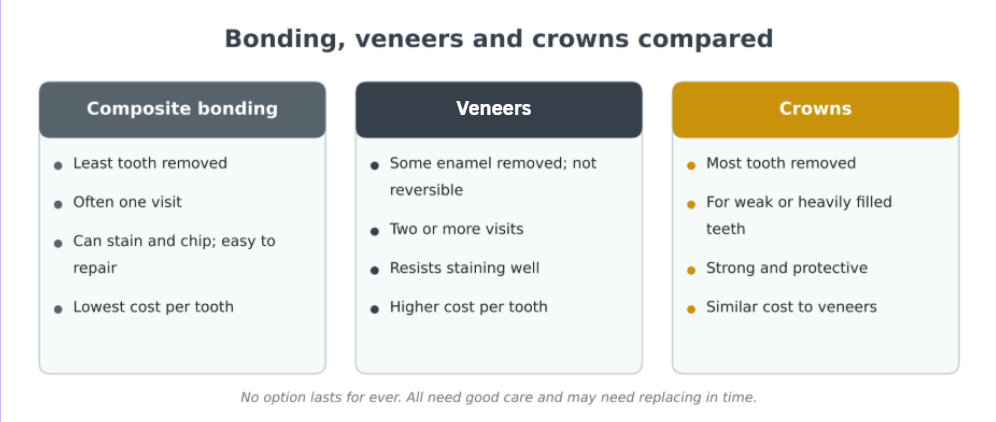
| Composite bonding | Veneers | Crown | |
|---|---|---|---|
|
Tooth removed |
Little or none |
Some enamel |
Most |
|
Reversible |
Largely |
No |
No |
|
Visits |
Usually one |
Two or more |
Two or more |
|
Staining |
Can stain over time |
Resists staining |
Resists staining |
|
Typical lifespan |
Around 5 to 7 years, with polishing and repair |
Around 10 to 15 years |
Around 10 to 15 years |
|
If it chips |
Easily repaired |
Usually replaced |
Usually replaced |
|
Best for |
Small changes on healthy teeth |
Larger changes in shape or colour |
Weak, broken or heavily filled teeth |
Lifespans are general guides and vary widely with your bite, habits and care. None can be guaranteed.
Are there simpler alternatives?
Often there are, and they should be considered first:
- Tooth Whitening if colour is the main concern
- Orthodontics if teeth are crooked or crowded. Straightening teeth first often means far less, or no, drilling is needed
- Replacing old stained fillings
- Doing nothing, which is always a valid choice
Things to consider before you decide
- It is a long-term commitment. Veneers and crowns will need replacing at some point, probably more than once in a lifetime, at further cost.
- Preparation cannot be undone. Each time a restoration is replaced, a little more tooth may be lost. Preparing a tooth also carries a small risk of the nerve becoming inflamed, which may need to be resolved via root canal treatment.
- Healthy foundations first. Decay and gum disease must be treated beforehand.
- Grinding shortens the life of all three. A night guard may be advised.
- Whitening first. Restorations do not change colour once made, so any whitening is done before the shade is chosen.
- Take your time. You should be given a written plan and a chance to think before committing. A trial mock-up on your own teeth can show the likely result before anything permanent is done.
“Turkey teeth”: veneers or crowns?
Some treatments advertised abroad as “veneers” are in fact full crowns, which involve cutting healthy teeth down to pegs. If you are comparing prices, ask exactly how much tooth will be removed. Make sure you are fully informed prior to proceeding with treatment, as some procedures are irreversible and can permanently damage your teeth. See our guide to dental work abroad.
Frequently asked questions
Does composite bonding damage teeth?
When done without drilling, it leaves the tooth underneath intact.
Do veneers look false?
Well-planned veneers are designed to suit your face and match your other teeth. Typically, the aim is to make the veneers ‘blend in’ and look as natural as possible.
Can I have just one or two teeth treated?
Yes. Matching a single tooth to its neighbours takes skill, but it is routinely done.
How do I look after them?
Brush and clean between your teeth as normal, attend check-ups and hygiene visits, and avoid biting hard objects.
Cosmetic dentistry in Bristol
Bristol Dental Specialists is a private specialist and referral practice at 24 Berkeley Square, Clifton, seeing patients from Bristol, Bath, Somerset, Gloucestershire and South Wales. Read more about cosmetic dentistry and composite bonding.
Your next step
If you are thinking about improving your smile, a consultation will show which options are suitable for your teeth, starting with the least invasive. You will receive a written plan and estimate, and time to think it over.
Call: 0117 450 2991 Online: contact us or book a consultation Dentists: refer a patient
Visit: Bristol Dental Specialists, 24 Berkeley Square, Clifton, Bristol, BS8 1HP
Important information. This article gives general information and is not a substitute for individual advice from a dental professional who has examined you. Suitability, risks, timings, costs and results vary from person to person. Bristol Dental Specialists is a private dental practice. Our dental professionals are registered with the General Dental Council (GDC), 37 Wimpole Street, London, W1G 8DQ, www.gdc-uk.org. If you are unhappy with any aspect of your care, please see our complaints procedure.

Opening Hours
Monday 8.00am – 7.00pm
Tuesday 8.00am – 7.00pm
Wednesday 8.00am – 6.00pm
Thursday 8.00am – 6.00pm
Friday 8.30am – 2.30pm
Saturday By arrangement only
Sunday Closed
Bristol Dental Specialists Ltd Registered in England & Wales company number 11696017
Bristol Dental Specialists, 24 Berkeley Square, Bristol, Gloucestershire, BS8 1HP. Telephone 0117 450 2991. Bristol Dental Specialists Ltd trading as Bristol Dental Specialists is a credit broker not a lender and is authorised and regulated by the Financial Conduct Authority, 914167. Registered in England & Wales 11696017. Registered Address: 24 Berkeley Square, Bristol, Gloucestershire, BS8 1HP.
© Copyright Bristol Dental Specialists 2020-26 | Website by QualiConvert